© 2026 Policy Network For Transitions. Tous droits réservés.
Agenda · PNT
Events & Gatherings
Seminars, conferences and workshops on major transitions — energy, geopolitical, demographic and digital.
Past Events
24
Jun
2026
Green Industrial Policy and the Political Economy of Energy Transition in North Africa
North African countries are confronting a set of intertwined challenges: accelerating climate and ecological crises; mounting pressures on water, food and energy systems; and the need to define viable development strategies in an increasingly fragmented global economy. Policymakers must thread a needle — building productive capacities, diversifying economic activity, securing a better insertion into global value chains, managing tight fiscal constraints, and ensuring that the broader transformation is socially inclusive and environmentally sustainable.
This workshop examined the political economy of green industrialisation in North Africa. Its primary task was to probe where the current energy transition can be conducive to inclusive development, and where it threatens to reproduce older patterns of extraction, dependency, exploitation and unequal integration into the global economy.
Tangier · June 2026
Detailed Programme
Framing Note
24–25 June 2026 · Hilton Garden Inn, Tangier
Green Industrial Policy and the Political Economy of Energy Transition in North Africa
General framing
Developing national industrial capabilities …
Success, however, is far from guaranteed …
Tuesday, 23 June 2026
7:00 PM – 9:00 PM
Welcome Dinner with Remarks
With the participation of the President of the Open Society Foundations, invited guests and participants.
Wednesday, 24 June 2026
8:30 AM – 9:00 AM
Welcome and Registration of Participants
9:00 AM – 10:30 AM
Session 1 · Governance, Power and the Political Economy of Energy Transition
The energy transition is not only a technical or environmental process; it is fundamentally political. Across North Africa and the wider MENA region, green industrial strategies are reshaping states, development models and the balance of power between domestic and international actors. In doing so, they are generating new political economies of development, marked by shifts in state intervention, industrial policy and governance.
In many countries, the transition is transforming the role of the state. Governments are expanding their functions as planners, regulators, investors and coordinators of industrial transformation, often through centralised decision-making structures aimed at accelerating investment in strategic sectors. While this may strengthen state capacity and long-term planning, it also raises questions about accountability, participation and the concentration of power.
Three broad trajectories are emerging across the region: voluntarist states seeking to actively drive the transition and implement structural reforms; conservative states aiming primarily to preserve existing economic and political arrangements; and a third group characterised by policy fragmentation or denial, where governments appear trapped in transition without a coherent strategy. These domestic transformations are embedded in broader global financial and geopolitical dynamics, as emerging green macro-financial regimes shape policy space and development choices.
Guiding questions
- What kinds of political economies are emerging through green transition projects?
- How are green transition policies affecting social contracts and public expectations regarding development and welfare?
- Can green industrial policy help energy-exporting countries diversify their economies and move beyond rentier development models?
- Are new green sectors creating productive transformation or simply new forms of rent allocation and elite accumulation?
- How are climate finance, development finance, sovereign wealth funds and private capital shaping national transition strategies?
Moderator
Hamza Meddeb — Fellow, Carnegie Middle East Center; Co-founder of the Policy Network for Transitions
Speakers
- Amel Boubaker — Tenure Track Professor, Aix-Marseille University
- Dawud Al Ansari — Founder, Shaheen Institute (Oman)
- Colin Powers — Director of Research, Noria (France)
- Fernando Santiago Rodriguez — Industrial Policy Officer, UNIDO
10:30 AM – 11:00 AM
Coffee Break
11:00 AM – 12:30 PM
Session 2 · Green Industrialisation in an Era of Fragmented Globalisation
The green transition is triggering the largest reorganisation of global production networks since the rise of globalisation in the 1990s. Electric vehicles, batteries, renewable energy technologies, critical minerals, hydrogen and low-carbon industrial products are creating new opportunities for countries seeking to move up global value chains.
For the MENA region, this moment presents a potentially historic opportunity. The region combines proximity to European markets, growing renewable energy potential, established manufacturing capabilities in sectors such as the automotive and fertiliser industries, and attractiveness to key investors in China and the Gulf. Yet integration into green value chains does not automatically lead to industrial development.
The global economy is becoming fragmented as major powers deploy industrial policies, subsidies, local content requirements and trade restrictions to secure strategic industries. Measures such as the EU's Carbon Border Adjustment Mechanism (CBAM) risk reinforcing forms of green protectionism and creating new barriers for developing countries. Against this backdrop, North African countries face a central challenge: how to transform participation in green global value chains into a process of industrial upgrading, technological learning and economic diversification rather than remaining dependent on foreign technology, imported inputs and volatile export markets.
Guiding questions
- What distinguishes successful industrial upgrading from simple participation in global value chains?
- Is CBAM primarily a threat to North African industry or a catalyst for industrial modernisation?
- Can MENA countries turn renewable energy abundance into a competitive advantage in steel, fertilisers, chemicals and hydrogen?
- Does the growing presence of Chinese firms in EVs, batteries and renewable technologies represent a new opportunity for technology transfer and industrial learning?
- Can North African countries leverage competition between China, Europe and Gulf investors to strengthen their bargaining position?
- What would success look like in ten years: more exports, deeper industrial ecosystems, technological capabilities, or greater strategic autonomy?
Moderator
Diala Hawila — Carboun Institute
Speakers
- Nora Abu Shadi — Associate Professor of Economics, Cairo University; Economic Research Forum (ERF)
- Alfonso Medinilla — Head, Climate Action and Green Transition, ECDPM
- Roberto Cardinale — Associate Professor, University College London (UCL)
- Byford Tsang — Senior Fellow, ECFR · participating online
12:30 PM – 2:00 PM
Lunch Break
2:00 PM – 3:30 PM
Session 3 · Green Interdependence or Green Extraction
The global push toward decarbonisation is reshaping economic and geopolitical relations across the Mediterranean. As Europe seeks to secure clean energy supplies and reduce its dependence on fossil fuels, North African countries are positioning themselves as key producers of green hydrogen, renewable electricity and other strategic inputs for the green transition. For governments in the region, these emerging sectors promise investment, export revenues, foreign exchange earnings and opportunities for industrial upgrading.
Yet this new green geography also raises fundamental questions about resources, sustainability and development. Does the green transition create the conditions for sustainable and inclusive growth, or does it merely reproduce existing patterns of extraction and dependency? This session explores these tensions through the lens of renewable energy projects, asking what a truly just green transition would require in North Africa.
Guiding questions
- What are the environmental and social costs of green investments?
- How will scarce water resources, land and renewable energy be allocated between domestic needs and export-oriented production?
- North Africa was historically integrated into global markets through hydrocarbons, phosphates and agricultural exports. What is genuinely new about green hydrogen?
- What happens when large-scale hydrogen projects intersect with water scarcity, agricultural needs and local livelihoods?
- Which communities stand to gain and lose the most from these projects?
- What conditions would allow hydrogen investments to contribute to industrial upgrading rather than simply exporting energy?
Moderator
Nada ElKamary — Research Associate, American University in Cairo (AUC)
Speakers
- Yasmine Zarhloul — Non-Resident Scholar, Carnegie Middle East Center (Morocco)
- Mohamed Younes — Energy and Environmental Policy Researcher (Egypt)
- Inesaf Benzaki — Campaigner, Greenpeace (Morocco)
- Imen Cherif — Member, MENAFEM Movement for Economic, Development and Ecological Justice (Tunisia)
3:30 PM – 4:00 PM
Coffee Break
4:00 PM – 5:30 PM
Session 4 · Financing Green Industrialisation — Capital, Constraints and Development Outcomes
This session examined how North African economies can finance climate adaptation and green industrialisation ambitions at a time when public finances are under pressure, borrowing costs remain high and economic vulnerabilities are deepening. Governments across the region are being asked to stabilise their economies, protect populations from increasingly frequent shocks, implement reform agendas and invest in the future, all while operating with limited fiscal space.
Financing green industrial ambitions cannot be separated from a broader development bargain aimed at generating growth, enabling structural transformation and creating quality jobs. European development institutions, Gulf sovereign wealth funds, Chinese low-carbon investments, climate finance mechanisms and private-sector partnerships are all playing increasingly important roles in shaping the region's green transition. Optimising the local return on investment requires strategic prioritisation, credible policy frameworks and a clear vision of developmental objectives.
Guiding questions
- What financing models are emerging across North Africa's green transition, and which actors are driving them?
- How is Gulf capital reshaping development trajectories through investments in green industrialisation, renewable energy and strategic infrastructure?
- What role should climate finance, development banks, sovereign wealth funds and private capital play?
- How can financing strategies balance economic competitiveness with social inclusion and resilience?
- What arrangements are needed to ensure that green transitions strengthen domestic capabilities rather than deepen debt burdens and inequality?
Moderator
Colin Powers — Director of Research, Noria
Speakers
- Bertha Argueta — Senior Policy and Advocacy Officer, Climate Justice, European Network on Debt and Development (EURODAD)
- Mohamed Wail Aaminou — Affiliate Professor, Green Growth, Mohammed VI Polytechnic University (UM6P)
- Mehran Haghirian — Director of Research and Programs, Bourse & Bazaar Foundation
- Rabeh Arezki — Director of Research, CERDI, CNRS · participating online
Thursday, 25 June 2026
9:00 AM – 11:00 AM
Round Table · Industrial Transformation in the Arab World — Lessons from the Past, Futures of the Green Transition
This roundtable looked backward to draw lessons from past industrialisation experiences, and forward to assess current trajectories. It situated current green industrial ambitions within the broader historical trajectory of industrial policy in the Arab world, examining the institutional and political foundations of successful industrial transformation: state capacity, long-term planning, coordination mechanisms, technological learning, bureaucratic effectiveness, human capital development, and the organisation of relations between public and private actors. A central question is why past industrial strategies in the region often failed to generate sustained structural transformation, and whether the green transition opens up genuinely new developmental possibilities.
Looking ahead, the region's industrial and energy futures are also being reshaped by geopolitical changes. Conflicts in the Middle East, disruptions in global supply chains and the growing securitisation of energy policy in Europe and Asia are likely to influence investment flows, industrial priorities and transition pathways across North Africa and the Gulf. At the same time, potential shifts in global oil demand may reshape Gulf investment strategies and redefine regional interdependencies.
Guiding questions
- What are the most important lessons from past industrialisation experiences in the Arab world?
- Why have many industrial policies in the region struggled to achieve sustained productivity growth and technological upgrading?
- What forms of state capacity are required to implement ambitious green industrial strategies?
- How can governments balance long-term planning with flexibility in a rapidly changing technological and geopolitical environment?
- How might declining long-term oil demand reshape Gulf investment strategies and regional interdependencies?
- How is geopolitical fragmentation reshaping global transition pathways, and what does this mean for North Africa's industrial future?
Moderator
Aram Belhadj — Professor of Economics, University of Nabeul (Tunisia)
Speakers
- Souad Dhaoui — Institut Tunisien de la Compétitivité et des Études Quantitatives (ITCEQ), Tunisia
- Nabil Jedlane — Professor of Economics, Abdelmalek Essaadi University, Tangier (Morocco)
- Redouane Raouf — Professor, Mohammed V University in Rabat (Morocco)
- Tayeb Amegroud — Energy Expert (Morocco)
- Jauad El Kharraz — Energy Expert (Morocco)
11:00 AM – 11:30 AM
Coffee Break
11:30 AM – 1:00 PM
Co-organisation

Public Panel · Climate Finance and Green Transitions in a Turbulent World
This public joint session, co-organised by the Policy Network for Transitions and the Rihla Initiative for Green Economic Growth, examined how climate finance and green transition strategies are being reshaped by a changing international environment. It focused in particular on the growing role of Gulf capital in green infrastructure, industrial development, renewable energy, food systems and urban transformation across the Global South. It also explored how Chinese involvement in green technologies, manufacturing, infrastructure and supply chains is changing the political economy of transitions.
Moderator
Mehran Haghirian — Rihla Initiative
Speakers
- Hamza Meddeb — Carnegie Middle East Center and the Policy Network for Transitions
- Dawud Al Ansari — Rihla Initiative
- Lydia El Bouazati — Rihla Initiative
- Nora Abu Shadi — Cairo University, Economic Research Forum (ERF)
- Matthias Larsen — London School of Economics and Political Science · participating online
- Iskander Erzini — Imal Initiative for Climate and Development · participating online
1:00 PM
Closing of the Workshop
Proceedings
PNT Workshop · Tangier
24–25 June 2026 · Tangier
Green Industrial Policy and the Political Economy of Energy Transition in North Africa
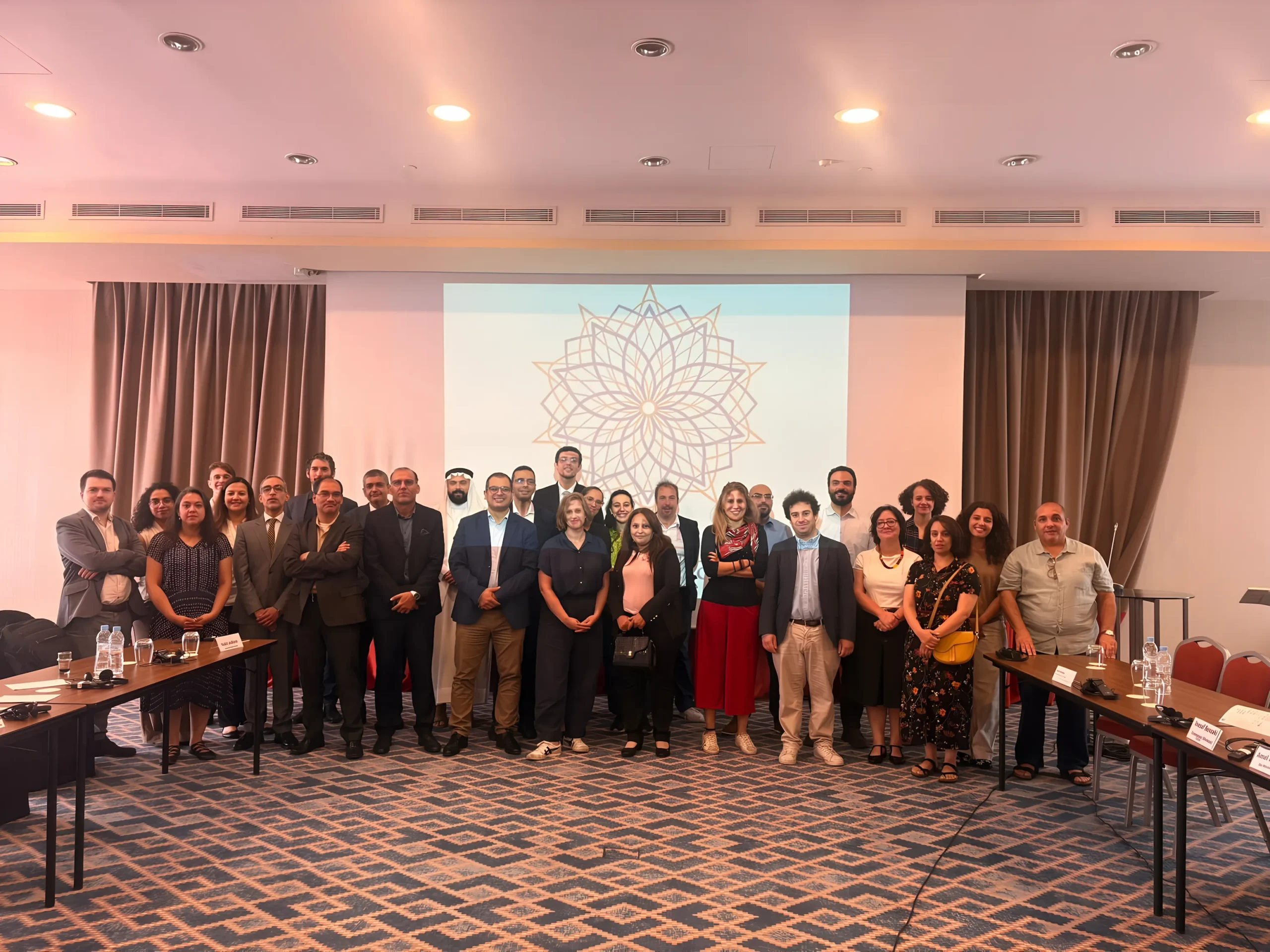
The workshop took place in Tangier and brought together more than thirty participants, including academics, experts and civil society representatives from across the MENA region. It opened from the premise that prevailing development paradigms are being fundamentally challenged by a rapidly evolving international environment: rather than temporary shocks, current economic and geopolitical disruptions signal a deeper structural transformation in the global political economy.
Read together, the sessions reveal a coherent analytical framework. The green transition should not be understood primarily as an environmental agenda. Decarbonisation, renewable energy and climate finance are undoubtedly important, but their significance derives less from their environmental objectives than from their capacity to support structural economic transformation. The transition matters not because it replaces fossil fuels with cleaner technologies, but because it creates an opportunity to reorganise productive systems, strengthen domestic capabilities and redefine long-term development trajectories.
The decisive question is not whether North Africa will participate in the global green transition, but whether it will do so as a producer of knowledge, technology and industrial capabilities rather than primarily as a supplier of energy and raw materials.
Contents
- Setting the stage: why development paradigms are being reconsidered
- Green transition as structural economic transformation
- Building productive capabilities: the central objective of green industrial policy
- Reimagining the developmental state: capacity, coordination, learning
- Navigating a fragmented world: agency, geopolitics and strategic integration
- Governing capital: finance, investment and the political economy of transformation
- Political ownership, social justice and the governance of transformation
- Towards a new political economy of green development
Part I
Setting the stage: why development paradigms are being reconsidered
The combination of accelerating climate change, technological competition, geopolitical fragmentation, shifting patterns of globalisation and renewed industrial policies has created a context in which many of the assumptions underpinning development strategies over the past three decades no longer appear adequate.
Throughout the discussions there was broad agreement that the era during which development was primarily understood through market liberalisation, macroeconomic stability and integration into global value chains has reached its limits. While these policies contributed to growth in many contexts, they often failed to generate the productive transformation, technological upgrading and resilience required for long-term development. Instead, many developing economies remain locked into low-value-added activities, highly dependent on commodity exports or external financing, and vulnerable to increasingly volatile international markets.
This reassessment coincides with profound changes in the behaviour of advanced economies themselves. The resurgence of industrial policy in the United States, the European Union, China and several middle-income countries represents a significant departure from the policy prescriptions traditionally promoted by international financial institutions. State interventionism, long portrayed as an obstacle to efficient markets, has returned to the centre of economic strategy through large-scale investments, targeted subsidies, strategic trade measures and technology policies.
The question is no longer whether governments should intervene in economic transformation, but how states can build the institutional capacity necessary to intervene effectively.
Participants also emphasised that development cannot be understood exclusively through macroeconomic indicators such as GDP growth. Sustainable development requires improvements in productivity, employment quality, technological capabilities and institutional effectiveness. The workshop therefore challenged narrow conceptions of economic success that overlook social inclusion, territorial inequalities and political legitimacy.
Box 1 — A more fragmented globalisation
- Not a retreat from integration, but a more selective and strategically organised global economy.
- Supply chains increasingly shaped by national security, technological sovereignty and geopolitical alliances.
- "Friend-shoring", "near-shoring" and "de-risking" as markers of this transition.
- For North Africa: proximity to European markets, renewable potential and demographic resources are real advantages — but not sufficient on their own.
Underlying these discussions was a broader conceptual shift regarding development policy itself. Rather than focusing primarily on correcting market failures, participants described development as a process of building productive capabilities — one that requires institutional adaptation and long-term coordination between public authorities, private firms, research institutions and financial actors. Development thus becomes an inherently political process requiring continuous negotiation, strategic prioritisation and institutional learning.
Part II
Green transition as structural economic transformation
One of the strongest themes emerging from the workshop was the rejection of a narrow understanding of the green transition as primarily an environmental or technological agenda. Across virtually every session, participants argued that decarbonisation should instead be understood as a process of structural economic transformation, capable of reshaping productive systems, industrial organisation and development trajectories. Climate policy, in this perspective, becomes inseparable from industrial upgrading, technological learning, employment creation and state capacity.
Renewable energy technologies were therefore presented less as final objectives than as instruments capable of supporting industrial transformation. Solar and wind resources, green hydrogen production, battery manufacturing and critical minerals all offer significant economic opportunities. Yet these opportunities are not necessarily developmental: countries may export renewable electricity, hydrogen or raw materials without substantially changing the underlying structure of their economies. The transition only becomes transformative when it generates domestic learning, technological upgrading and new productive capabilities.
Participants repeatedly returned to this distinction between participation and transformation. Many developing economies have successfully integrated into international production networks while remaining confined to relatively low-value activities such as resource extraction, assembly or basic manufacturing. The challenge for North African countries is therefore not merely to enter green industries, but to progressively occupy more sophisticated segments of production involving engineering, research, design, advanced manufacturing and innovation.
This emphasis fundamentally alters the rationale for industrial policy. Traditional industrial policies often focused on protecting specific sectors or promoting domestic manufacturing through tariffs and subsidies. The discussions in Tangier instead highlighted a more dynamic understanding centred on capability accumulation: green industrial policy is valuable not because it supports particular technologies, but because it creates opportunities for firms, workers and institutions to acquire new knowledge, master increasingly complex production processes and develop competitive domestic industries.
Under a scenario of green extractivism, North African countries would supply renewable electricity, hydrogen or critical raw materials to external markets while importing the technologies, machinery and high-value services associated with these sectors. Carbon emissions might decline, but the underlying international division of labour would remain largely unchanged.
| Dimension | "Green extractivism" pathway | "Productive transformation" pathway |
|---|---|---|
| Global insertion | Export of energy and raw materials | Gradual move into engineering, design and advanced manufacturing |
| Technology | Imported machinery and services | Domestic learning, R&D, absorptive capacity |
| Productive fabric | Enclave projects, few local linkages | Supplier networks, SMEs, industrial ecosystems |
| Employment | Limited, largely temporary jobs | Skilled jobs, training, engineering |
| Outcome | Lower emissions without structural change | Diversification, resilience and expanded agency |
Avoiding this outcome requires a deliberate focus on domestic value creation: strengthening local supplier networks, supporting small and medium-sized enterprises, encouraging technology transfer, developing engineering capabilities and expanding research and development. Productive transformation depends less on the quantity of investment attracted than on the quality of the productive linkages generated within the domestic economy.
The discussions also challenged the assumption that technological change naturally diffuses through foreign direct investment. Technology transfer was repeatedly described as an institutional rather than a commercial process: learning requires active interaction between domestic firms, universities, research centres, technical institutes and public agencies.
Finally, participants argued that the green transition creates a rare historical window of opportunity. The simultaneous restructuring of global energy systems, industrial production and international value chains opens new possibilities for late industrialisation — but these opportunities will not remain available indefinitely.
Part III
Building productive capabilities: the central objective of green industrial policy
If one concept consistently underpinned the discussions, it was that of capabilities. Although speakers approached the subject from different disciplinary perspectives — economics, political science, development studies, finance, energy policy — they repeatedly returned to the same proposition: the ultimate objective of industrial policy is not simply to increase investment, expand production or improve exports, but to build the productive capabilities upon which long-term development depends.
Box 2 — What "capabilities" include
- The technical skills required by firms and the engineering competencies of workers.
- The technological knowledge embedded within research institutions.
- The managerial capacities of enterprises.
- The administrative competence of public agencies.
- The financial expertise necessary to mobilise long-term investment.
These different forms of knowledge reinforce one another. Industrial transformation does not result from the accumulation of physical capital alone; it depends equally upon organisational and institutional capabilities that allow societies to absorb, adapt and improve technologies over successive generations.
Capabilities, participants insisted, cannot simply be imported. Technologies may be purchased, foreign firms may establish production facilities and external investors may finance infrastructure — yet productive capabilities themselves emerge through processes of learning that are necessarily domestic, cumulative, collective and deeply embedded within national institutions.
This understanding places learning at the centre of industrial policy. Rather than the implementation of a predetermined blueprint, development was described as an adaptive process through which governments and firms gradually acquire practical knowledge. Successful industrial policies are not those that avoid mistakes altogether, but those capable of learning from experimentation, identifying successful initiatives and correcting failures before they become systemic.
Several speakers explicitly challenged the assumption that market forces alone generate such learning. Firms often underinvest in training because skilled workers may subsequently leave; private investors frequently avoid research whose benefits extend beyond individual companies; universities may remain disconnected from industrial needs. These coordination problems justify an active role for public institutions — not to replace markets, but to facilitate the collective learning upon which competitive industries depend.
Participants further argued that industrial ecosystems constitute the environments within which learning occurs. Competitive firms rarely develop in isolation; they emerge within dense networks linking manufacturers, suppliers, universities, vocational training centres, financial institutions, regulatory agencies and public administrations. Green industrial policy should therefore focus not only on attracting flagship investments but also on strengthening these broader ecosystems — including the small and medium-sized enterprises through which knowledge diffuses across the wider economy.
Capability accumulation is cumulative and path-dependent. Countries rarely move directly from resource extraction to technological leadership. Patience therefore becomes a strategic virtue.
Part IV
Reimagining the developmental state: capacity, coordination, learning
Few concepts received greater attention than state capacity. Yet the understanding emerging from the discussions differs significantly from traditional conceptions: rather than advocating a return to state-led production or central planning, participants articulated a vision of the developmental state centred on coordination, institutional learning and strategic governance.
Participants therefore consistently described the state as a coordinator rather than simply a regulator. Structural transformation requires investments that span multiple sectors and institutions simultaneously. Renewable energy projects depend upon electricity grids, ports, logistics, vocational training, universities, financial systems and research institutions — none of which can be developed independently.
Coordination also extends to the relationship between industrial policy and other domains of public policy. Several speakers argued that industrial strategies frequently fail because they remain disconnected from education, research, infrastructure, financial regulation or territorial development. Industrial policy should therefore be understood less as a sectoral intervention than as an organising framework linking multiple public institutions around common developmental objectives.
Another recurring theme concerned institutional continuity. Industrial transformation unfolds over decades, whereas political systems often operate within much shorter cycles. Governments change, priorities shift, administrative reforms are introduced and subsequently abandoned. One defining characteristic of successful developmental states is their ability to preserve strategic continuity while remaining sufficiently flexible to adapt to changing circumstances.
Several participants also highlighted the importance of what might be termed embedded autonomy. Governments require sufficient autonomy to pursue long-term developmental objectives, yet they must remain closely connected to productive actors in order to understand evolving technological and market conditions. Continuous dialogue between public authorities, private firms, business associations, universities and civil society enables governments to identify emerging constraints while avoiding excessive bureaucratic isolation.
State capacity is inseparable from political capacity: the ability to generate consensus around long-term national development objectives while managing the social tensions generated by structural change.
Taken together, these discussions point towards a renewed conception of the developmental state. The state emerges neither as a substitute for markets nor as a passive regulator, but as the institution responsible for organising collective learning and aligning public and private actors around shared developmental goals.
Part V
Navigating a fragmented world: agency, geopolitics and strategic integration
Participants treated the international environment less as a fixed external constraint than as a dynamic political space within which states retain meaningful room for manoeuvre. Deterministic interpretations of globalisation were rejected in favour of an emphasis on agency — the capacity of governments to shape their own development trajectories despite growing geopolitical uncertainty.
The international context described throughout the workshop differs fundamentally from that which shaped development debates during the final decades of the twentieth century. Rather than moving towards greater integration under a relatively stable liberal order, the global economy is increasingly characterised by geopolitical rivalry, technological competition and strategic fragmentation. Major powers have returned to industrial policy; trade has become more closely intertwined with national security; supply chains are being reorganised according to strategic rather than purely economic considerations; and climate policy itself has become an instrument of industrial competition.
These transformations should not be read only as sources of instability. As major powers compete to secure critical minerals, renewable energy supplies, industrial partnerships and technological leadership, countries capable of articulating coherent development strategies may find themselves in a stronger negotiating position than during previous phases of globalisation.
This observation was particularly relevant for North Africa. The region combines several structural advantages that are becoming increasingly valuable within the emerging international economy.
Box 3 — North Africa's structural assets
- Proximity to European markets: lower transport costs and greater attractiveness for near-shoring strategies.
- Abundant solar and wind resources: a potential hub for renewable energy and green hydrogen.
- Existing manufacturing sectors — automotive, electrical equipment, fertilisers and chemicals — providing foundations for more sophisticated green industries.
- A pivotal position between Europe, sub-Saharan Africa and the Gulf, allowing partnerships to be diversified rather than concentrated on a single economic pole.
Geography creates opportunities; institutions determine whether these opportunities are realised.
Strategic autonomy was never presented as economic isolation or national self-sufficiency, but as the capacity to make meaningful policy choices within an interdependent world. Countries possessing diversified productive structures, capable public institutions and strong technological capabilities enjoy greater freedom to negotiate with external partners because they are less dependent upon any single source of finance, technology or export demand. Agency therefore derives from capability.
These discussions also led participants to reconsider international cooperation itself. Europe remains an essential partner because of its market size, technological capabilities and regulatory influence. However, China, the Gulf countries, African regional organisations and multilateral development institutions also offer distinct forms of cooperation. The challenge is not to choose between competing geopolitical blocs but to combine different partnerships in ways that maximise domestic developmental benefits — which requires governments to define clear industrial priorities before engaging with international partners.
A final recurring idea was that geopolitical fragmentation increases the importance of resilience. Recent crises — the pandemic, geopolitical conflicts, disruptions to global shipping — have highlighted the vulnerabilities associated with excessive dependence on geographically concentrated supply chains. Industrial policy thus becomes not only a strategy for growth but also an instrument for reducing strategic vulnerability.
Part VI
Governing capital: finance, investment and the political economy of transformation
While international discussions on climate finance have often focused on mobilising greater volumes of investment, the workshop proposed a different analytical perspective: the central question is not whether sufficient financial resources exist globally, but how capital is governed, allocated and embedded within broader processes of productive transformation. Finance is not simply an enabling condition for industrial development; it is itself one of the principal arenas through which development trajectories are shaped.
This perspective begins by recognising a striking paradox. North African countries possess some of the world's most favourable renewable energy resources and increasingly attractive industrial opportunities, yet they also face significantly higher borrowing costs than advanced economies. The principal obstacle to green industrialisation is therefore not necessarily the cost of renewable technologies, but the cost of capital itself: macroeconomic instability, sovereign risk perceptions, currency volatility and underdeveloped domestic financial systems frequently offset the competitive advantages created by abundant renewable resources.
A major point of discussion concerned the merits of blended finance. Participants acknowledged its potential while cautioning against treating private capital mobilisation as an objective in itself. Public guarantees and concessional finance undoubtedly reduce investment risks, but the ultimate criterion should remain developmental impact rather than financial leverage alone.
Several speakers also questioned the dominant project-based approach to climate finance. Renewable energy investments are often evaluated individually according to narrowly defined commercial criteria, whereas industrial transformation depends upon broader systems of complementary investments: electricity generation requires transmission infrastructure; green hydrogen depends upon water management, ports, engineering services, research institutions and specialised training; manufacturing competitiveness relies upon logistics, certification systems, supplier networks and financial services.
The workshop therefore advanced a broader conception of development finance in which financial institutions support industrial ecosystems rather than individual assets. Public investment banks, national development funds and multilateral institutions can play particularly important roles in coordinating long-term investments whose benefits extend well beyond individual firms — and in supplying the patient capital that short-horizon financial markets systematically underprovide.
The growing importance of sovereign wealth funds, particularly those originating in the Gulf, was viewed as a significant opportunity, while participants stressed that recipient governments must remain attentive to the broader developmental implications of such investments. Financial partnerships should be assessed not only according to the capital they provide, but according to their contribution to domestic technological capabilities, local supplier development and industrial diversification.
Domestic financial systems matter just as much. Banking sectors across much of North Africa continue to favour relatively low-risk activities, while venture capital, equity markets and innovation financing remain comparatively underdeveloped. Strengthening these domestic ecosystems therefore constitutes an important component of long-term industrial strategy.
Who governs capital, according to which priorities, and for whose benefit? Financial systems are never neutral: they influence which sectors expand, which technologies diffuse, which firms survive and which regions receive investment.
Perhaps the most original contribution of the workshop was its implicit expansion of state capacity into what might be described as financial state capacity — development banks, public investment funds, export credit agencies, sovereign financing mechanisms and regulatory institutions capable of influencing patterns of capital allocation. Industrial policy ultimately depends upon the state's ability to govern finance as much as its ability to regulate production.
Part VII
Political ownership, social justice and the governance of transformation
Beyond industrial policy, finance and technological change, the workshop consistently returned to a broader political question: under what conditions can structural transformation become socially legitimate and politically sustainable? The success of the green transition will ultimately depend less upon technological feasibility than upon the ability of societies to build political coalitions capable of sustaining long-term change. Green industrialisation is therefore not merely an economic strategy; it is fundamentally a political project.
This perspective was introduced from the opening session, where representatives of the Open Society Foundations reflected upon the evolution of the organisation's own thinking. Rather than presenting democracy, economic development and climate action as separate agendas, they argued that these challenges have become increasingly interconnected. Democratic institutions cannot remain resilient if they coexist with persistent economic insecurity, declining social mobility and limited prospects for younger generations; equally, economic transformation cannot succeed without capable public institutions and broad political legitimacy.
This political dimension proved particularly relevant for North Africa. Several participants observed that the region has experienced successive waves of externally encouraged reform, from structural adjustment programmes and market liberalisation to democratic transition initiatives. Although many of these reforms pursued legitimate objectives, they often remained only partially implemented or insufficiently embedded within domestic political institutions — weakening existing institutional arrangements without generating broadly accepted alternatives.
The workshop repeatedly returned to this experience as a lesson for the green transition. Unless climate policies, industrial strategies and new regulatory frameworks become integrated into nationally defined development projects, they risk reproducing earlier patterns of incomplete institutional change. The transition should therefore not be framed primarily around compliance with international climate obligations or external regulatory standards, but as a domestic development strategy capable of generating employment, strengthening productive sectors, improving public services and expanding economic opportunities.
Participants consistently rejected the idea that climate action and social justice constitute competing priorities. On the contrary, the political viability of decarbonisation depends precisely upon its capacity to improve living standards while reducing environmental risks.
Social inclusivity is therefore critical. Women, young people and historically marginalised communities must be integrated into new industrial opportunities if the transition is to generate durable legitimacy: technical education, vocational training, entrepreneurship programmes and improved access to skilled employment all contribute to ensuring that green industrialisation benefits wider segments of society. So too do earnest consultations with communities affected by investment projects.
Owing to their prodigious use of land and water, many of the region's major solar and wind farms have brought profound disruptions to livelihoods and forms of communal life — and have rarely generated employment at scale. This must change.
The workshop also highlighted the importance of developmental coalitions. Structural transformation inevitably redistributes economic opportunities and alters existing power relations, so governments require broad alliances bringing together public institutions, private firms, universities, financial organisations, labour representatives and civil society. Industrial policy consequently becomes a process of collective governance rather than unilateral state intervention.
Perhaps the most original political insight concerns the relationship between agency and ownership. States cannot exercise meaningful agency internationally unless development strategies are simultaneously rooted in broad domestic consensus. National ownership therefore becomes the political foundation upon which international bargaining power ultimately rests.
Part VIII
Towards a new political economy of green development
| Domain | Priority emerging from the discussions |
|---|---|
| Industrial policy | Shift from sectoral protection to capability accumulation and learning |
| Value chains | Move from participation to upgrading in higher-value segments |
| State capacity | Coordination, policy coherence and strategic continuity |
| Technology | Treat transfer as an institutional process requiring absorptive capacity |
| Finance | Govern capital allocation; support ecosystems, not isolated projects |
| Geopolitics | Diversify partnerships; define priorities before negotiating |
| Social justice | Inclusion of women, youth and affected communities as a condition of legitimacy |
A coherent framework rather than a list of recommendations
The workshop sessions addressed a wide range of subjects: industrial policy, governance, global value chains, climate finance, technological capabilities, geopolitical fragmentation and social inclusion. Read together, however, they reveal a remarkably coherent analytical framework. Rather than producing a collection of disconnected policy recommendations, the discussions progressively articulated a broader vision of development adapted to the profound transformations currently reshaping the global political economy.
For North Africa, the opportunities presented by the ongoing green transition are real, though so too are the risks. The region possesses substantial renewable resources, growing industrial experience and a strategic geographical position linking Europe, Africa and the Middle East. Yet these advantages will generate sustainable development only if they are accompanied by investments in knowledge, institutions and productive capabilities.
Conclusion — transformation as an open-ended process
Rather than presenting a blueprint applicable to every country, the workshop encourages a different way of thinking about transformation itself. Development is understood as an open-ended process of learning through which societies progressively expand their capacity to shape their own futures. Green industrial policy becomes valuable precisely because it creates the institutional conditions under which this learning can occur.
In this sense, the discussions did more than analyse North Africa's response to climate change. They contributed to a broader reconsideration of the political economy of development in the twenty-first century.
The transition is not simply about moving towards cleaner sources of energy. It is about building economies that are more productive, more resilient, more inclusive and more capable of exercising agency within an increasingly fragmented international order.
19
May
2026
Sovereignty Under Strain: Energy, Economic Security and the Future of Tunisia
The workshop organised by the Policy Network for Transitions (PNT) in Paris on 19 May 2026 took an external geopolitical shock as its starting point — the war in the Middle East, tensions around the Strait of Hormuz, and rising energy and input prices — in order to pose a deeper question: does Tunisia still possess the economic, institutional and political capacities that would allow it to absorb prolonged shocks without entering a sequence of disorderly adjustment?
The principal lesson of the debates is that the current crisis does not create Tunisia's vulnerabilities; it reveals them, accelerates them and connects them.
Detailed Programme
Framing Note
19 May 2026 · BOPE, Paris
9:00 AM – 9:25 AM
Welcome & Registration
9:25 AM – 10:30 AM
Session 1: The War in the Middle East as a Revealer of the Tunisian Economy's Vulnerabilities
This first session analyses the channels through which the Middle Eastern crisis is transmitted to the Tunisian economy. It examines the combined effects of rising oil prices, the increased cost of inputs, imported inflation, pressure on the balance of payments and the potential worsening of fiscal imbalances. The aim is to understand how an external geopolitical shock can rapidly become an internal macroeconomic shock.
9:25 AM – 9:50 AM
The War in the Middle East and Its Macroeconomic Effects on Tunisia
Ali Kooli
Former Minister of the Economy
This presentation offers a macroeconomic reading of the impact of the war in the Middle East on the Tunisian economy. It analyses the effects of rising energy and commodity prices on the state budget, the trade balance, inflation, foreign-currency reserves and growth. The presentation also seeks to identify the areas of immediate vulnerability: pressure on subsidies, deficit financing, the cost of energy imports, strains on public enterprises and the risk of social transmission of the inflationary shock.
9:50 AM – 10:15 AM
A Country in Denial? Macroeconomic Imbalances, Debt and the Cost of Inaction
Hachemi Aleya
Economist and Founder of ECOWEEK
This presentation starts from the observation that Tunisia remains insufficiently prepared to absorb a lasting external shock. It examines the gap between official budgetary assumptions and the more cautious macroeconomic outlooks established by international institutions, particularly with regard to growth, inflation, the deficit and indebtedness.
It raises the central question of financing: how can a lasting rise in the prices of energy, cereals and agricultural inputs be addressed in a context of reduced fiscal room for manoeuvre? The presentation highlights the risks associated with a painful economic landing: a higher-than-expected deficit, increased recourse to borrowing, debt strains, pressure on the dinar and the probable necessity of unpopular trade-offs.
10:15 AM – 10:30 AM
Discussion
10:30 AM – 11:00 AM
Coffee Break
11:00 AM – 12:30 PM
Session 2: Energy Dependency — The Cost of Non-Transition
This second session focuses on the structure of Tunisia's energy dependency and on the strategic cost of the accumulated delay in the energy transition. Tunisia remains heavily dependent on imports of hydrocarbons and natural gas, particularly for its electricity generation. This dependency exposes it to price volatility, regional tensions and the geopolitical constraints associated with supply routes.
The session also addresses Tunisia's place in the Mediterranean energy equation: the role of Algerian gas, transit towards Italy, the limits of capitalising on the TransMed gas pipeline, the risk of being bypassed by alternative projects such as GALSI, the diversification of oil supplies and the delay in renewables.
11:00 AM – 11:25 AM
Why Is Tunisia's Energy Transition Stalling?
Mongi Marzouk
Former Minister of Energy
This presentation analyses the structural blockages that hold back the adoption of renewable energy in Tunisia. While the country has strong solar and wind potential, the share of renewables remains limited and projects advance slowly. The presentation examines the regulatory, institutional, financial and technical obstacles that delay the transition: administrative procedures, grid connection, the role of STEG, uncertainties for investors, governance of the sector and the absence of a clear industrial vision.
It shows that the development of renewables is not merely an ecological choice, but an economic and strategic imperative. Reducing dependence on imported gas, securing electricity generation, lowering the energy bill, creating jobs and structuring local value chains are all objectives that place the energy transition at the heart of the national debate.
11:50 AM – 12:30 PM
Discussion
12:30 PM – 2:00 PM
Lunch
2:00 PM – 3:30 PM
Session 3: The Looming Food Crisis and Social Tensions — The Impossible Reform of Subsidies?
This third session analyses the link between energy shock, food security and social stability. Rising oil prices and disruptions to the global petrochemical chain can drive up the cost of fertilisers, urea, ammonia, plastics and transport. These dynamics directly affect agriculture, the food industries, distribution and consumer prices.
The session also examines the role of the subsidy system. It remains an essential social stabiliser, but it also constitutes a major budgetary constraint. The central question is therefore one of trade-offs: how can vulnerable households be protected without indefinitely worsening the deficit? Can subsidies be reformed without provoking a social crisis? How can price policy, food security and fiscal sustainability be reconciled?
2:00 PM – 2:25 PM
Agricultural Inputs, Food Security and External Vulnerability
Jérémy Denieulle
Director of Studies, Agriculture Stratégies
This presentation analyses the effects of the energy and petrochemical crisis on Tunisian food security, and more broadly in North Africa. It shows how rising prices for urea, ammonia, fertilisers, fuels and transport can affect agricultural yields, drive up local production costs and increase dependence on food imports.
It frames food security as a strategic issue: can Tunisia continue to treat agricultural inputs as mere commercial commodities? What mechanisms of anticipation, stockpiling, support for farmers and diversification of supplies should be put in place to limit the effects of external shocks? What is the effect of this crisis on sulphur, the principal input of Tunisia's chemical and phosphate-processing industry?
2:25 PM – 2:50 PM
Subsidies, Price Policy and Social Tensions: The Difficult Reform of Compensation in Tunisia
Karim Belkhiria
École Normale Supérieure
This presentation focuses on price policy and the reform of the compensation system in Tunisia. It analyses the historical role of the subsidy system as an instrument of social stabilisation, but also as a source of budgetary rigidity. In a context of rising international prices for energy, cereals and inputs, the question of compensation becomes central: maintaining subsidies is increasingly costly, but cutting them abruptly may fuel inflation and provoke social tensions.
The presentation examines the political and social conditions for a possible reform: targeting of aid, direct compensation, gradual reform, price transparency, protection of vulnerable households and the rebuilding of mechanisms for social dialogue. It also discusses the risks of a reform carried out without trust, without mediation and without a clear political narrative.
2:50 PM – 3:30 PM
Discussion
3:30 PM – 4:00 PM
Coffee Break
4:00 PM – 6:00 PM
Session 4: What Scenarios for Tunisia? Reforms, Trade-offs and Solutions
Discussion moderated by Michaël Ayari and Hamza Meddeb
This final session is devoted to scenarios for emerging from the crisis and to possible reforms. It aims to bring into dialogue the economic, energy, food-related and social analyses developed over the course of the day in order to identify the available room for manoeuvre.
The discussion focuses on short- and medium-term scenarios: an optimistic scenario of gradual stabilisation, an intermediate scenario of prolonged tensions, and a pessimistic scenario of the simultaneous worsening of energy, budgetary, food and social constraints. It also addresses the question of the IMF: should Tunisia resume a financial agreement? Can it do without one? Under what conditions could external support be politically and socially sustainable?
Participants discuss priority reforms: accelerating the energy transition, reforming subsidies, building strategic stocks, diversifying supplies, protecting critical agricultural inputs, modernising refining, capitalising on Tunisia's Mediterranean energy role and constructing an integrated approach to economic security.
The objective of this session is not to produce a technocratic list of recommendations, but to set out the terms of a strategic debate: how can an energy and budgetary vulnerability be transformed into the starting point for a policy of economic sovereignty? How can the crisis be prevented from translating solely into costly social adjustments? And how can energy security, food security, social justice and political stability be articulated within a single framework for action?
6:00 PM
Closing of the Workshop
Proceedings
PNT Workshop
19 May 2026 · Paris
Sovereignty Under Strain — Energy, Economic Security and the Future of Tunisia
The workshop organised by the Policy Network for Transitions (PNT) in Paris on 19 May 2026 took an external geopolitical shock as its starting point — the war in the Middle East, tensions around the Strait of Hormuz, and rising energy and input prices — in order to pose a deeper question: does Tunisia still possess the economic, institutional and political capacities that would allow it to absorb prolonged shocks without entering a sequence of disorderly adjustment?
The principal lesson of the debates is that the current crisis does not create Tunisia's vulnerabilities; it reveals them, accelerates them and connects them. Energy dependency increases budgetary pressure; budgetary pressure reinforces the banking system's dependence on financing the state; rising energy prices and the interruption of supplies of agricultural inputs that transit through the Strait of Hormuz spread to food prices and purchasing power; the delay in the energy transition prolongs external dependence; and the weakening of social mediation mechanisms makes any reform of prices or subsidies more difficult.
The workshop thus proposed reading the Tunisian crisis not as a juxtaposition of sectoral problems, but as a systemic chain in which energy, agriculture, currency, public finances and social stability become interdependent.
Tunisia is entering a phase in which its room for manoeuvre is shrinking simultaneously on several fronts: weak growth, stalled public and private investment, energy dependency exceeding two-thirds once the Algerian gas royalty is neutralised, a low share of renewables, significant food dependency, banking fragility, rapid monetary expansion and a growing difficulty in financing the state without crowding out the productive economy.
Tunisia can no longer content itself with a reactive management of crises. It must build a doctrine of economic sovereignty articulating energy security, food security, subsidy reform, the strategic recapitalisation of the state, the rehabilitation of productive investment and the restoration of mechanisms of trust.
The central question is therefore not merely whether Tunisia should resume an agreement with the IMF or not; it is which economic and social project could make external support politically useful, economically effective and socially sustainable.
Contents
- Politicising vulnerabilities: PNT's analytical framework
- An economy weakened even before the geopolitical shock
- The Middle Eastern shock as a multiplier of vulnerabilities
- Energy dependency: the strategic cost of non-transition
- Food security: from cereals to inputs
- Compensation: between social buffer and budgetary lock
- Three scenarios for the coming years
- Towards a doctrine of economic sovereignty
Part I
Politicising vulnerabilities: PNT's analytical framework
From the outset, the organisers recalled that the aim is not to juxtapose specialised diagnoses on energy, public finances or agriculture, but to understand how these dimensions are articulated within a single system of vulnerabilities.
The Tunisian case appears particularly revealing in this respect. Tunisia combines a strong energy dependency, an unfinished energy transition, significant food dependency, a subsidy system that is difficult to reform, weak growth, an under-invested productive apparatus and weakened institutions. It thus constitutes a laboratory for the tensions that many states of the Global South will face in a context of geopolitical fragmentation, global energy transition and the multiplication of shocks.
Energy prices, subsidies, agricultural inputs, foreign-currency reserves, monetary statistics and storage capacities are not mere technical variables. They constitute the concrete sites where the material sovereignty of states is at stake.
Politicising these issues does not mean ideologising them. It means making visible the power trade-offs, the distributive effects and the institutional constraints that determine how they are managed.
Part II
An economy weakened even before the geopolitical shock
Box 1 — Macroeconomic warning signals
- Real GDP contracting in the first quarter of 2026, according to the analyses presented during the workshop.
- GDP per capita below its pre-Covid level.
- Activity rate around 45%, among the lowest in Africa.
- Strong growth in the money supply and cash.
- Credit to the economy slowing while financing of the state increases.
- Public investment in decline and private investment almost at a standstill.
The debates underlined that Tunisia is not approaching the Middle Eastern shock from a position of resilience, but from an economy that is already deeply weakened.
The growth officially reported on a year-on-year basis masks a more degraded reality. According to the analyses presented during the workshop, Tunisia's real GDP would have declined by approximately 0.3% in the first quarter of 2026, while year-on-year comparisons benefit mainly from a base effect linked to the weakness of activity in 2025.
GDP per capita remains below its level prior to the Covid-19 crisis. This prolonged stagnation reflects less a cyclical crisis than a progressive exhaustion of the Tunisian growth model.
The situation of the labour market illustrates this silent degradation. Speakers stressed that the unemployment rate is no longer sufficient to describe the real state of the economy. The central problem now lies in the collapse of the activity rate.
According to the figures discussed during the workshop, Tunisia's activity rate would have fallen to around 45%, one of the lowest in Africa and far below the global average. This decline reflects both the absence of job creation and the silent withdrawal of a growing share of the population from the labour market.
Investment constitutes a second major warning signal. Participants converged on the observation of a country that no longer invests sufficiently. Public investment budgeted in the finance laws is very largely under-executed, while private investment appears almost at a standstill.
Tunisian banks themselves point to the absence of genuine structuring investment projects. Imports of capital goods have remained depressed for several years, and the rare recoveries observed seem more linked to one-off purchases than to a genuine productive dynamic.
But the core of the diagnosis presented during the workshop concerns the monetary and financial structure of the Tunisian economy.
The figures from ECOWEEK and the Central Bank show a strong expansion of the money supply. According to ECOWEEK No. 19-26, the M3 money supply grew by 10.5% year-on-year in the first quarter of 2026, while credit to the economy increased by only 3.1%. Banknotes and coins rose by 17.8%, reaching 27.3 billion dinars, or 18.3% of M3. Cash relative to GDP reached 15.1%, compared with 11.7% in 2021, even as credit to the economy grew weakly. Banknotes and coins in circulation are rising rapidly, while the share of cash in GDP is reaching historically high levels.
This evolution reflects several simultaneous phenomena: real inflation stronger than officially measured, growing distrust of the banking system, the rise of the informal sector and a preference for holding foreign currency.
The debates particularly emphasised the transformation of the Tunisian banking system into an instrument for financing the Treasury.
Banks now hold a growing share of sovereign debt, while credit to businesses slows sharply. The more banks finance the state, the less they finance the real economy. The more they accumulate sovereign risk, the more vulnerable they become to a budgetary crisis.
The Central Bank itself appears increasingly mobilised in the service of financing the state, which fuels concerns about a monetisation of the deficit.
This dynamic feeds what several participants described as a genuine fiduciary crisis. Credit to the central government now represents 37.2% of GDP, according to the figures discussed during the workshop, compared with 17.6% in 2021. The Central Bank holds 35.5% of claims on the state on its balance sheet, while Tunisian banks carry nearly 18.7% of sovereign claims among their assets.
The economy continues to function, but at the cost of a growing dependence on monetary expansion, domestic indebtedness and the capture of financial resources by the state.
Part III
The Middle Eastern shock as a multiplier of vulnerabilities
The war in the Middle East acts as a systemic stress test for the Tunisian economy.
The debates stressed a central point: the crisis is not transmitted solely through prices. It is also transmitted through the physical availability of goods, logistical disorganisation, tensions on maritime routes and the lengthening of supply lead times.
The energy shock thus rapidly becomes a budgetary shock, then a productive shock and finally a social shock.
Rising oil and gas prices immediately increase the cost of energy subsidies, weigh on the trade deficit and exert additional pressure on foreign-currency reserves.
But the effects then spread to agricultural inputs, transport costs, fertilisers, refined products and all production chains.
The debates showed that Tunisia is particularly vulnerable to this logic of cascading transmission.
Energy dependency increases pressure on the budget; this budgetary pressure reinforces the banking system's dependence on financing the state; rising energy costs are transmitted to food prices; and inflation reduces the purchasing power of already weakened households.
Several presentations also underlined that Tunisian adjustment is already taking place partly through shortages.
When the state can no longer simultaneously finance all the necessary imports, it prioritises certain products considered politically sensitive — notably the soft wheat destined for subsidised bread — at the expense of other components of the food or industrial system.
This logic progressively weakens the dairy, meat and animal-feed sectors, while degrading the nutritional quality of consumption.
The Middle Eastern crisis thus reveals less a temporary problem than a growing structural dependence on external supply chains that have become unstable.
Part IV
Energy dependency: the strategic cost of non-transition
Box 2 — Tunisian energy dependency in 2026
- Energy dependency: around 65–66% when counting the Algerian gas royalty.
- Dependency close to 70% excluding the royalty.
- More than 90% of electricity produced from natural gas.
- Share of renewables in electricity generation: around 3%, according to the debates.
- One-off imports of Algerian electricity during summer peaks.
- Significant delay in storage and grid infrastructure.
The second session of the workshop helped to clarify the nature of Tunisia's energy dependency.
According to the figures raised during the debates and the technical presentations, Tunisia covers only between 30 and 35% of its energy needs, depending on whether the gas royalty linked to Algerian transit is included.
The official energy dependency rate reaches around 65%, but it would be close to 70% if the TransMed royalty were neutralised.
This precision is important, because part of the energy counted as a national resource in fact depends on an external geopolitical flow.
Gas constitutes the nodal point of this dependency. Tunisian electricity generation still relies more than 90% on natural gas, mainly imported from Algeria. Gas dependency thus becomes an electrical, industrial and budgetary dependency.
The discussions recalled that Tunisia had had to import Algerian electricity during recent summer consumption peaks, including in periods when Algeria was itself carrying out power cuts on its own territory.
This relationship creates an asymmetric interdependence: Tunisia remains far more vulnerable to a supply interruption than Algeria is to a loss of Tunisian transit.
The presentation devoted to the energy transition nevertheless stressed an essential point: the transition to renewable energy cannot be conceived as a simple technical substitution.
Solar and wind are intermittent resources. Their integration requires storage capacities, robust grids, interconnections, suitable governance and a STEG capable of ensuring the stability of the electrical system.
Electricity, moreover, represents only a fraction of final energy consumption. Transport, certain industrial uses and thermal uses remain heavily dependent on hydrocarbons.
Tunisia's delay in renewables is therefore not explained by the absence of solar or wind potential. It results from a combination of factors: budgetary crisis, financing difficulties, the weakness of STEG, administrative delays, regulatory instability and the absence of a structured industrial ecosystem.
The debates also underlined the risk of an energy transition reduced to a purely extractive logic.
If the large renewable projects are developed exclusively by international companies, without local content, without an industrial strategy and without training, Tunisia will indeed reduce part of its energy bill, but without building a genuine national productive fabric.
The energy transition would then become a mechanism for reducing the external deficit, without any deep transformation of the economic model.
Part V
Food security: from cereals to inputs
Box 3 — Hormuz: a food chokepoint as much as an energy one
- Around 20% of global oil trade transits through Hormuz.
- One-fifth of global LNG trade depends on the strait.
- 35% of global urea exports transit through it.
- Nitrogen fertilisers remain strongly correlated with gas markets.
- A lasting disruption would directly affect global agricultural costs.
The third session of the workshop profoundly shifted the food debate.
The Tunisian problem does not lie solely in dependence on cereal imports; it concerns the entire agricultural production chain.
The presentation devoted to agricultural inputs recalled a central idea: a country that is vulnerable in its inputs is vulnerable across its entire food chain.
Modern agriculture relies on a heavy consumption of energy, fertilisers, transport and chemical products.
Natural gas, ammonia, urea, sulphur, fuels, maritime insurance and trade routes have become essential components of food security.
The Strait of Hormuz was thus presented as a food chokepoint as much as an energy one. The data discussed during the workshop recall that around 20% of global oil trade, one-fifth of global liquefied natural gas trade and 35% of global urea exports transit through this maritime route.
A major share of global trade in oil, liquefied natural gas and urea passes through it. A lasting disruption of this route directly affects fertiliser costs, then agricultural yields and finally global food prices.
Tunisia appears particularly vulnerable in this configuration.
Its cereal self-sufficiency rate remains low, while its storage capacities, water resources and input production remain limited.
The climate crisis further accentuates these constraints. The exploitation of deep aquifers is reaching critical levels, and water fragility pushes agriculture to compensate with more chemical inputs, which further increases external dependence.
The debates therefore proposed moving beyond the unrealistic objective of full cereal self-sufficiency in order to think in terms of genuine food sovereignty from the upstream.
This approach implies securing critical inputs, diversifying suppliers, building strategic stocks and rethinking agricultural policies in connection with energy and climate constraints.
Part VI
Compensation: between social buffer and budgetary lock
The discussion on compensation showed that Tunisian subsidies cannot be reduced to a mere budgetary burden.
The compensation system constitutes at once a mechanism of social stabilisation, a historical instrument of price management and an implicit component of the Tunisian social contract.
The debates recalled that compensation has been progressively institutionalised since the 1940s in a context of provisioning, drought and price control.
Over time, it became a buffer between international prices and domestic prices.
This historical depth explains why any reform appears politically sensitive.
Compensation does not only protect consumers. It also reduces uncertainty for certain producers, notably in the bakery, cereals and processed-food sectors.
But this system also produces distortions: delays in reimbursement, the concentration of actors able to absorb administrative delays, dependence on the state and the growing opacity of real costs.
Participants stressed that an abrupt abolition of subsidies would be socially explosive.
But the absence of reform would prolong another type of adjustment: hidden inflation, shortages, degradation of product quality and the worsening of deficits.
The real challenge is therefore to move gradually from a generalised system of opaque subsidies to a targeted, legible and sustainable social protection system.
Such a reform cannot, however, succeed without social mediation, without a reliable social register and without a political strategy capable of explaining the trade-offs.
Part VII
Three scenarios for the coming years
The debates converged on three possible scenarios.
The first scenario, an optimistic one, rests on a gradual stabilisation of the Middle Eastern context, an easing of energy and input prices, a limited recovery of investment and external financial support enabling certain margins of manoeuvre to be progressively restored.
This scenario remains conceivable, but it presupposes a significant improvement in economic governance, institutional coordination and the credibility of reforms.
The second scenario, considered the most probable in the short term, is one of prolonged tensions.
The economy would then continue to operate in low gear: weak growth, persistent inflation, insufficient investment, growing internal financing of the deficit and diffuse social adjustment.
In this configuration, shortages would remain occasional but recurrent, and the state would continue to prioritise incompressible expenditure at the expense of investment and the maintenance of infrastructure.
The third scenario is one of a simultaneous worsening of energy, food, budgetary and monetary constraints.
In this case, a lasting rise in energy prices combined with logistical disruptions and a weakening of the dinar could lead to major tensions: import difficulties, rapid degradation of public energy enterprises, acceleration of food inflation and the multiplication of social tensions.
Adjustment would then no longer take place through reform, but through rationing, shortages and the accelerated degradation of public services.
Part VIII
Towards a doctrine of economic sovereignty
| Scenario | Main characteristics | Dominant risks |
|---|---|---|
| Gradual stabilisation | Partial energy easing, external support, limited investment recovery | Insufficient reforms, weak growth |
| Prolonged tensions | Persistent inflation, stagnation, diffuse adjustment | Erosion of purchasing power, social fatigue |
| Systemic worsening | Lasting rise in energy prices, pressure on currency and imports | Shortages, social tensions, institutional crisis |
| Domain | Priority |
|---|---|
| Macroeconomics | Restore budgetary and monetary credibility |
| Banking and credit | Reduce the bank-sovereign nexus |
| Energy | Develop renewables, storage and grid |
| Agriculture | Secure critical inputs |
| Compensation | Gradual and targeted reform |
| Industry | Build local content around the transition |
Building new indices of sovereignty
One of the most original contributions of the workshop lies in the implicit proposal to move beyond the classic indicators used to measure Tunisia's economic vulnerability.
The debates showed that indicators such as the official energy dependency rate or the cereal self-sufficiency rate are no longer sufficient to describe the country's real vulnerabilities.
With regard to energy, several speakers proposed reasoning in terms of effective energy sovereignty. Such an index should integrate not only official national production, but also dependence on Algerian gas, the weight of the TransMed royalty, dependence on imported refined products, storage capacities, electrical interconnections, the financial soundness of STEG and the country's ability to rapidly substitute its supplies.
The same logic applies to food. The debates stressed the need to build an index of food vulnerability through inputs. This should integrate dependence on urea, ammonia, phosphate fertilisers, sulphur, agricultural fuels, maritime freight and the foreign currency required for imports.
These approaches make it possible to shift the debate: sovereignty is no longer measured solely by final production, but by a system's capacity to withstand prolonged disruptions of supply chains.
This reflection opens a broader undertaking for PNT: rebuilding analytical tools capable of conceiving the systemic vulnerabilities of North African states in a world marked by geopolitical, climatic and energy shocks.
The five strategic priorities
The final session of the workshop clearly established that Tunisian responses can no longer take the form of a mere accumulation of technical reforms.
Tunisia must build a genuine doctrine of economic sovereignty articulating energy security, food security, monetary stability and social justice.
The first priority consists in restoring macroeconomic credibility.
This presupposes a transparent diagnosis of the budgetary and monetary situation, a clarification of the reality of foreign-exchange reserves, better coordination between the Ministry of Finance and the Central Bank, and an objective assessment of the real cost of subsidies.
The second priority concerns the reconstruction of productive investment.
An economy in which banks mainly finance the state cannot generate sustainable growth. It becomes indispensable to gradually reduce the bank-sovereign nexus, to address the situation of public banks and to redirect credit towards productive sectors.
The third priority is the acceleration of the energy transition within an industrial logic.
Renewables must be integrated into a strategy of grid, storage, local content, training and territorial justice.
STEG must be reformed without being dismantled. It must become an operator capable of stabilising an electrical system increasingly based on intermittent generation.
The fourth priority consists in rethinking food security on the basis of inputs.
Strategic stocks must no longer concern only cereals, but also fertilisers and certain critical inputs.
Finally, the fifth priority is the gradual overhaul of the compensation system.
A sustainable reform must be gradual, targeted and socially negotiated. It must protect vulnerable households while recognising the productive functions of certain subsidies.
Conclusion — From rhetorical sovereignty to material sovereignty
The workshop showed that Tunisia does not only lack resources; it lacks room for manoeuvre.
Yet sovereignty is measured first not by national rhetoric, but by a state's capacity to anticipate, finance, arbitrate, protect and transform.
The war in the Middle East reveals a Tunisia vulnerable to energy, food, financial and social shocks.
But this crisis can also open a strategic moment.
If it agrees to confront its fragilities, Tunisia can transform constraint into an agenda of reconstruction: an energy doctrine, a food strategy based on inputs, an intelligent reform of compensation, the recapitalisation of the banking system, the rehabilitation of productive investment and the rebuilding of a social pact around justice and economic sovereignty.
The central question is therefore not only: how can the crisis be avoided?
It is deeper: how can a national project be rebuilt in a world where shocks are becoming the norm?
03
Apr
2026
Acting Before the Tipping Point: The Development Crisis, the End of Multilateralism and Strategic Challenges for the Global South
PNT was born out of a shared observation: the societies and states of North Africa have entered a phase in which economic, social, climatic and geopolitical transitions can no longer be addressed through sectoral, technocratic or purely reactive responses. The gradual withdrawal of traditional donors, the weakening of multilateralism and the brutalisation of international relations now make autonomous strategic capacity indispensable.
PNT's objective is to encourage North African elites to adopt a long-term strategic approach in order to address increasingly urgent challenges, including the entry into a post-development phase, the intensification of climate change effects, the energy transition and the fragmentation of the global economy.
Detailed Programme
Framing Note
3 April 2026 · Hôtel Crowne Plaza, Paris
2:30 PM – 3:00 PM
Welcome & Registration
3:00 PM – 3:10 PM
Presentation of the Policy Network for Transitions (PNT)
PNT was born out of a shared observation: the societies and states of North Africa have entered a phase in which economic, social, climatic and geopolitical transitions can no longer be addressed through sectoral, technocratic or purely reactive responses. The gradual withdrawal of traditional donors, the weakening of multilateralism and the brutalisation of international relations now make autonomous strategic capacity indispensable.
PNT's objective is to encourage North African elites to adopt a long-term strategic approach in order to address increasingly urgent challenges, including the entry into a post-development phase, the intensification of climate change effects, the energy transition and the fragmentation of the global economy.
3:10 PM – 3:20 PM
Seminar Theme
Moderation: Dr Nadia Marzouki
The inaugural seminar of the Policy Network for Transitions aims to open a space for reflection on a major transformation of the international system: the joint crisis of development and humanitarian action in a context of accelerated geopolitical recomposition.
The massive reduction in development aid budgets, the loss of credibility of multilateral institutions, the collapse of the normative power of Western donors and the rise of a transactional international order pose major challenges for countries of the Global South.
In this new context, countries of the Global South face a triple challenge: the tendency towards denial and deferred decision-making; the progressive disappearance of traditional frameworks for assistance and stabilisation; and the need to rethink the modalities of integration into the global economy.
Located at the interface between sub-Saharan Africa and Europe, North Africa occupies a central strategic position in these transformations.
3:20 PM – 3:40 PM
Rethinking the Current Geopolitical Moment: Challenges and Opportunities for the Mediterranean
Dr Karim Emile Bitar
Holder of the Georges Corm Chair in Political Economy and International Relations, Saint Joseph University (Lebanon) · Lecturer at Sciences Po Paris
The world has entered an unprecedented geopolitical moment, in which the rules of trade, development aid, humanitarian action and global governance are being redrawn.
The countries of the southern Mediterranean are now compelled to reassess this moment and to navigate these profound transformations.
3:40 PM – 4:00 PM
Resilience, Efficiency and Strategic Autonomy: The Winning Triptych for Global South Countries in a Multipolar World
Dr Alexandre Kateb
Expert · Director of The Multipolarity Project
The rise of protectionism and trade barriers of all kinds, the return of industrial policies, the assertion of energy security imperatives and the transformation of global financial rules are progressively entrenching the fragmentation of the global order.
Without claiming to sketch a recipe for success in an increasingly uncertain world, this global moment is pushing countries of the Global South to develop a strategic positioning articulating resilience, efficiency and strategic autonomy.
4:00 PM – 4:20 PM
Towards the End of Humanitarianism and Development: What New Models and What Consequences for African and North African Countries?
UN Expert
This presentation will analyse the structural crisis of the international development and humanitarian aid system in a context of geopolitical fragmentation and the sustained withdrawal of traditional donors.
It will examine the emergence of new models based on risk management, insurance mechanisms and the increased involvement of the private sector in fragile and post-conflict contexts.
4:20 PM – 5:50 PM
Open Discussion
5:50 PM
Cocktail Reception
Proceedings
Inaugural Seminar
3 April 2026 · Paris
Acting Before the Tipping Point: The Crisis of Development, the End of Multilateralism, and Strategic Challenges for the Global South
The inaugural seminar of the Policy Network for Transitions, held in Paris with around thirty participants, confirmed the founding intuition of the organisation: we are no longer in a moment of transition still to come, but in a world that has already been transformed — where inherited categories such as development, multilateralism, governance and democracy have lost their explanatory and operational power.
Contents
Part I
What the seminar contributed to PNT's identity
The discussions revealed a shared diagnosis: the geopolitical shift has already taken place. Multilateralism is no longer a structuring framework, but an eroding system. International norms are contested or circumvented. Power relations are being reshaped around logics of raw force, regional fragmentation and generalised transactionalism. In this context, states — including those in North Africa — increasingly appear as weakened entities, caught between sovereigntist rhetoric and the effective loss of sovereignty.
This observation profoundly redefines PNT's mission. The organisation cannot situate itself either in the continuation of traditional aid frameworks or within technocratic, sectoral approaches. It positions itself as a space for the repoliticisation of contemporary issues, aiming to reintroduce the political dimension where it has been displaced by technical categories such as resilience, governance, efficiency and transition.
The exchanges also highlighted a fundamental shift in the development paradigm. International aid, historically tied to a multilateral order and to a function of projecting influence, is being transformed into a system of risk management — heavily financialised and oriented towards mobilising the private sector. This transformation is accompanied by a shift of responsibility onto local actors, without any real redistribution of capacities for action. Development thus ceases to be a project of transformation and becomes a mechanism of adaptation to exogenous constraints.
In this context, the notion of agency emerged as central. Who decides? Who acts? Who bears responsibility for transformations?
The dominant response today tends to marginalise local societies while externalising strategic decisions. PNT's specific objective is precisely to contribute to rebuilding this capacity for action, by articulating strategic reflection, critical analysis and the production of alternative frameworks.
Another major insight from the discussions concerns the need to think transitions in their plurality and interdependence. Energy transition, industrial transformation, technological mutations, geopolitical reconfigurations and social evolutions can no longer be addressed in isolation. They belong to the same historical moment, characterised by uncertainty, unpredictability and acceleration.
In such an environment, strategy can no longer be conceived as linear planning grounded in stable assumptions. It must integrate volatility, conflictuality and the possibility of abrupt ruptures. This means moving beyond managerial approaches to governance in order to reintroduce political reflection on trade-offs, priorities and trajectories.
Finally, the inaugural seminar underlined the specific role of North Africa as a strategic space. Located at the interface between Africa, Europe and the Middle East, the region concentrates the effects of global reconfigurations: the fragmentation of multilateralism, the redefinition of value chains, security tensions and the transformation of development models. It is at once a space of vulnerability and a potential laboratory for strategic recomposition.
Within this framework, PNT sees itself as an incubator for collective strategic reflection, capable of bringing together actors from different backgrounds — researchers, practitioners, decision-makers and civil-society members — in order to produce analyses rooted in regional realities while engaging with global dynamics.
The aim is not to propose immediate solutions, but to rebuild the conditions for autonomous strategic thinking — a prerequisite for any form of sovereignty, development, and ultimately, democratisation.
Part II
Synthesis of presentations and discussions
A shift that has already occurred
The roundtable organised by the Policy Network for Transitions takes place in a context marked by a profound transformation of the international system. One of the most striking observations from the discussions is that the geopolitical shift is no longer a hypothesis but a reality. The post-Cold War world — structured by multilateralism, international norms and Western hegemony — is now fading away.
Participants converge on the idea that we have entered a world characterised by fragmentation, the rise of power-based logics and the erosion of normative frameworks. This transformation affects not only international relations, but also the paradigms of development, humanitarian action and conflict management.
1. The end of multilateralism and the return of power politics
Karim's intervention offered an unambiguous diagnosis: the world has already shifted towards an order marked by the primacy of force. Multilateralism is in deep crisis, while major powers adopt logics of direct confrontation.
Features of the new context
- A return to openly assumed power politics
- A questioning of traditional alliances
- A hybridisation between neoconservatism and transactional logic
- A rise in messianic and ideological discourses
The main consequence is structural instability, marked by heightened risks of regional fragmentation, particularly in the Middle East. This dynamic challenges the very foundations of the rules-based international order.
2. The structural crisis of development
The contributions of Alexandre and the UN expert highlight a deeper crisis: that of the development paradigm itself. Historically, development appears as a geopolitical instrument inscribed in the logic of the Cold War. From its very origins, it has been crossed by contradictions between political, economic and normative objectives.
Manifestations of the current crisis
- The failure of structural adjustment policies
- The depoliticisation of economic debates
- The loss of credibility of international institutions
- The reduction of funding for the most vulnerable countries
More fundamentally, development is being transformed into a system of risk management, centred on the financialisation of aid, the use of instruments such as blended finance, and the transfer of risks onto local actors. This evolution marks the shift from a project of transformation to a logic of adaptation.
3. The centrality of sovereignty and agency
A central theme of the discussions is that of agency and sovereignty. Participants stress that the fundamental question is no longer that of development as such, but of the capacity of states and societies to act.
In a context of global predation, the priority becomes the preservation of capacities for action: the capacity to define autonomous strategies, to resist external pressures, and to anticipate transformations. This reflection leads to a relativisation of certain traditional priorities — notably democracy and governance — which appear secondary in the face of issues of survival and sovereignty.
4. Rethinking strategy in an unpredictable world
The discussions reveal a transformation in our relationship to time and strategy. In a world marked by uncertainty and volatility, traditional planning approaches appear ill-suited.
Strategy must now integrate the unpredictability of actors, the centrality of emotions and perceptions, the personalisation of power and the acceleration of technological transformations. This requires moving beyond linear approaches in favour of more flexible frameworks, capable of adapting to unstable environments.
5. Africa and North Africa as strategic spaces
Africa appears as one of the principal spaces of transformation on a global scale. It combines rapid demographic growth, strategic resources and significant economic potential.
North Africa, in particular, occupies a pivotal position at the interface between Europe, Africa and the Middle East. This position confers on it a strategic role in the ongoing reconfigurations. However, the region faces several challenges: economic stagnation, political fragmentation, external dependency and the absence of structuring projects.
Conclusion: rebuilding strategic thinking capacity
The roundtable highlights the need to rethink frameworks of analysis and action in depth. Inherited paradigms no longer make it possible to understand or act in today's world.
In this context, the role of initiatives such as PNT is crucial. The aim is to rebuild a capacity for strategic reflection by combining critical analysis, knowledge production and the networking of actors. The stakes are not only intellectual. They are political: the goal is to give societies back the capacity to define their own future in a world of recomposition.
Part III · Articulated synthesis
From post-multilateralism to post-development: repoliticising strategy in a fragmenting world
The historical moment we have entered can no longer be understood as a simple phase of gradual transition. On the contrary, the discussions converged on the idea that the shift has already occurred. We are not on the eve of a change in the international order; we are already living in the world that follows. This observation, which runs through both geopolitical analyses and reflections on development, requires us to thoroughly revise the categories that have structured international political thought in recent decades.
Multilateralism, development, governance, resilience — even democratisation itself — can no longer be invoked as self-evident truths or as neutral frameworks. They must be re-examined in light of their historical conditions of formation, their political uses and their current exhaustion.
One of the most important achievements of the discussion was precisely its refusal to treat as separate what dominant language presents as distinct domains: geopolitics on one side, development on the other; conflicts on one side, public policy on the other; systemic constraints on one side, national room for manoeuvre on the other. On the contrary, everything today points to a growing entanglement of the political, economic, technological, military and social.
The vocabulary remains that of development, cooperation or stability, even though the underlying logics are now those of power, securitisation, fragmentation and risk management.
The end of a normative order
The idea that the contemporary international system remains structured — even imperfectly — by a normative order inherited from 1945 is becoming increasingly untenable. The principles that formed the moral and legal architecture of post-war multilateralism — collective security, respect for sovereignty, refusal of annexation by force, centrality of international law — still exist on paper but no longer produce the organising effects once attributed to them.
What emerged through the exchanges is the idea of a post-normative order — not in the sense that all norms have disappeared, but in the sense that norms no longer effectively constrain the conduct of powers. They are invoked, selected, circumvented or suspended depending on the balance of power.
The geopolitical shift has already taken place. The monsters are no longer on the horizon; they are in power.
This formulation, which marked the discussion, does not simply refer to the rise of more brutal or cynical leaders. It points to a deeper mutation: the disappearance of the mediations that once allowed domination to be wrapped in a language of principles, rights or universality. We have not simply returned to classical realpolitik. We are dealing with a more unstable configuration that combines nineteenth-century power politics, neoconservative residues and unapologetic transactionalism.
The consequences of this shift are particularly visible in the Middle East, where war, radicalisation and dynamics of fragmentation have ceased to be anomalies and become ordinary modes of governing the region. What is alarming here is not only war as such, but the way fragmentation itself tends to become a fatality.
This change of context also forces us to revise the way we think about strategy. In a universe marked by post-truth, by the hyper-volatility of discourses and by the extreme personalisation of power, strategy can no longer be conceived as it was in a relatively predictable world. The rise of idiosyncrasy, the growing importance of leaders' psychology, the role of emotions, fear and sad passions are profoundly transforming the conditions of political decision-making.
Development as a political fiction in crisis
This crisis of multilateralism entails a parallel — but not separate — crisis of development. Development has never been a purely technical domain. From its origin, it was a geopolitical project. It was not first and foremost about organising shared prosperity, but about stabilising spaces deemed vulnerable, containing adversaries and structuring a global hierarchy in which certain states defined desirable trajectories for others.
The history of development is, in this respect, a history of successive displacements. First tied to colonial logics and then to the post-war order, it was reshaped by structural adjustment programmes, by economic liberalisation, then by discourses on good governance, the fight against corruption, human development, sustainable development and finally resilience. Each of these sequences shifted the terms of the problem without ever questioning the central one: who defines priorities, who bears the costs, and to whose benefit are these policies conducted?
It is precisely this vocabulary that is now wavering. Good governance, resilience, efficiency and strategic autonomy were presented as neutral, almost universal, management notions. Yet they belong to a managerial logic that transposes onto states categories designed for corporations. They obscure power relations, international hierarchies, material asymmetries and distributive conflicts.
This evolution is particularly visible in the rise of the resilience paradigm. Whereas development still claimed — even if often illusorily — to transform economic and social structures, resilience merely seeks to make shocks bearable. It no longer promises emancipation; it organises the capacity to absorb pain.
From aid to risk management
The contemporary turn of the international aid system can be summarised as the shift from a paradigm of transformation to a paradigm of risk management. In practice, the aim is no longer to produce development in the strong sense, but to mitigate shocks, secure investments and maintain environments stable enough to remain integrable into the global economy.
Within this framework, aid is becoming financialised. The dominant instruments are now guarantees, insurance schemes, blended finance arrangements and first-loss coverage mechanisms. The stated aim is to mobilise the private sector — to move from billions to trillions. But the real logic lies elsewhere: it is less about funding social needs than about reducing investors' exposure to risk.
This transformation is accompanied by a profound shift in the distribution of responsibility. The decisive question is that of agency. Who acts? Who decides? Who is held accountable? The emerging system has the peculiarity of transferring the burden of adaptation onto local societies while keeping decision-making centres outside. Local communities become responsible for managing risks they neither created nor have the means to address at their structural roots.
The growing reliance on the private sector is presented as a pragmatic response to the exhaustion of public funding. Yet there is no indication that it can meet the needs of the most fragile contexts. What appears at this stage, on the contrary, is a concentration of flows towards intermediate contexts, extractive sectors and spaces deemed profitable or strategic, while the most vulnerable regions remain structurally underfunded.
Politicising: what does repoliticising mean?
One of the most fruitful questions raised during the discussion was: what exactly does politicising mean? Politicisation does not merely mean reintroducing ideological discourse where supposed neutrality reigns. It first consists in re-establishing the links between decisions presented as technical and the power relations they organise.
To politicise the energy transition, for instance, is not to moralise the debate; it is to ask the questions that technocratic language tends to evacuate: who pays the cost of the transition, who captures the green rent, which productive fabric is reinforced, what energy or industrial sovereignty is being pursued, and on which social and political coalitions such a transition can be built.
To be political today means seeking to regain agency and to restore sovereignty — not in the sense of authoritarian hardening, but in the sense of reclaiming real margins of decision.
Sovereignty, stagnation and survivalism
Sovereignty emerged as the central concept of the moment. But the exchanges also showed how saturated with ambiguity this term has become. Today, there are sovereigntisms without sovereignty, anti-imperialist discourses without real autonomy, and resistance rhetoric devoid of productive, institutional or social capacity.
A crucial point of the debate was the insistence that a state does not protect its sovereignty through authoritarianism alone. On the contrary, authoritarianism — when combined with economic stagnation, structural inefficiency and the closure of horizons — fuels exponential instability. Sovereignty requires capacities, flexibility, strategic insertion in the regional context and the preservation of vital interests.
The notion of stagnation makes it possible to understand violence, fragmentation and disenchantment not only as products of political conflicts, but also as effects of an exhaustion of historical promises. North African societies live in an in-between space where the old narratives of progress have lost their credibility, without new structuring projects having emerged. This is what was meant by countries without a project.
At the same time, certain regional contexts — notably the Levant — already operate under a logic of survival. While the Levant faces an existential threat and lives in the immediacy of survivalism, North Africa still has, despite worsening conditions, a space in which to project itself. This relative "luxury" creates a particular responsibility. It makes all the more urgent the construction of a strategic thinking capable of preventing the region from also sliding into pure survival mode.
Africa and North Africa as strategic spaces
Another important contribution of the discussion was to shift the gaze towards Africa — not as a mere periphery of crises to manage, but as one of the principal spaces of growth, resources and recomposition on a global scale. This perspective requires a break with a linear vision of development.
The contributions emphasised the disruptive nature of certain African dynamics: the rapidity of social transformations, the rise of new generations with direct access to global knowledge, the growing role of Euro-African diasporas, and the emergence of forms of entrepreneurship, innovation and circulation of knowledge that escape old patterns.
However, this opening is not automatic. It runs up against major structural blockages, particularly in the fields of energy, critical technologies, water, infrastructure and industrial alliances. One cannot seriously speak of artificial intelligence, technological transition or reindustrialisation without raising fundamental questions: who controls energy, who owns the chips, who masters supply chains, who secures water, which inputs are strategic, and which regional resources may serve as geopolitical leverage.
North Africa, in this perspective, is neither a simple extension of Europe nor an appendix of the Middle East. It must be thought of as a distinct strategic space, located at the intersection of the Maghreb, sub-Saharan Africa, the Arab neighbourhood and the Mediterranean. The point is no longer to think the Maghreb solely through a European lens, but to reflect on its place in a world where its relations with Africa, the Middle East and the Global South are becoming decisive.
What is to be done?
The final question that runs through the entire seminar is the question of "what is to be done?". It received no simple answer — and that is fortunate. But the debates allow us to sketch a few guiding lines.
Three guiding lines
- Avoid the temptation of tabula rasa. The complete collapse of institutions would not mechanically open a space for reconstruction; it would risk installing prolonged anarchy from which societies would emerge even weaker.
- Refuse depoliticisation. PNT's whole effort consists precisely in reopening the space for strategic thinking that does not abandon conflicts, power relations or sovereignty issues to technocracy.
- Rebuild projects. Not abstract utopias or imported visions, but situated, ambitious projects capable of articulating sovereignty, social justice, productive capacity, regional integration and emancipatory horizons.
The word emancipation, proposed in conclusion, is essential here. It allows us to overcome the sterile alternative between technocratic resignation and empty radical rhetoric. It reminds us that the central question is not only that of survival, but that of the capacity of societies to once again become the actors of their own trajectory.
The specific task of a space such as the Policy Network for Transitions: not to produce yet another commentary on the crises of the present, but to contribute to reformulating the terms of the debate, clarifying concepts, connecting issues too often fragmented, and making thinkable what dominant language renders invisible.
At a time when the old myths are unravelling and instruments outlive their ends, strategic thinking once again becomes a condition of action — and perhaps, more fundamentally, a condition of sovereignty.